Vastu for Attached Bathrooms: Practical Remedies to Prevent Energy Drain in Modern Homes
One of the most common questions in modern Vastu is:
Are attached bathrooms bad Vastu?
The concern comes from the fact that in traditional Indian homes, toilets and bathing areas were often located:
- outside the main house,
- away from sleeping areas,
- and separated from living spaces.
Today, however, almost every apartment, villa, and modern home includes:
- attached bathrooms,
- en-suite toilets,
- walk-in washrooms,
- and integrated bathroom designs.
This creates a challenge because ancient Vastu principles were developed long before modern floor plans existed.
The good news is:
Modern Vastu focuses on remedies and balance, not fear.
Even if your bathroom is attached to your bedroom, there are many practical ways to reduce potential energy imbalances.
Why Attached Bathrooms Are a Modern Vastu Challenge
Bathrooms perform an important function:
They are spaces where the body releases:
- waste,
- toxins,
- and used water.
Because of this, Vastu associates bathrooms with:
- elimination,
- drainage,
- cleansing,
- and release.
While these functions are necessary, they also represent energy moving out of the home.
This is why bathrooms are often linked with:
Energy Drain
Bathrooms in Ancient Vastu vs Modern Homes
Traditional homes had:
- outdoor sanitation areas,
- separate bathing spaces,
- courtyards,
- and large property layouts.
Modern homes prioritize:
- convenience,
- privacy,
- compact designs,
- and efficient plumbing.
As a result:
Attached bathrooms have become standard in:
- apartments,
- condos,
- villas,
- and urban homes.
Vastu today adapts to these realities through practical remedies.
Why Bathrooms Are Associated with Energy Drain
According to Vastu symbolism:
Bathrooms involve:
- water flow,
- drainage systems,
- waste removal,
- and constant outflow.
These factors represent:
- letting go,
- release,
- and movement away.
This is why excessive bathroom-related issues may sometimes be symbolically connected with:
- fatigue,
- financial leakage,
- emotional heaviness,
- or relationship strain.
Common Problems Linked to Attached Bathrooms
Traditional Vastu concerns include:
Possible Issues
- disturbed sleep,
- emotional restlessness,
- lack of privacy,
- excessive moisture,
- stagnant energy,
- unpleasant odors.
Interestingly, many of these concerns also have practical explanations involving:
- hygiene,
- ventilation,
- and environmental comfort.
Does Every Attached Bathroom Create Negative Vastu?
No.
This is one of the biggest misconceptions.
Many modern homes with attached bathrooms function perfectly well.
The real issue is often:
- poor maintenance,
- water leaks,
- bad ventilation,
- clutter,
- or poor placement.
A clean, organized bathroom creates far fewer Vastu concerns than a neglected one.
The Importance of Bathroom Location
Different directions carry different symbolic meanings.
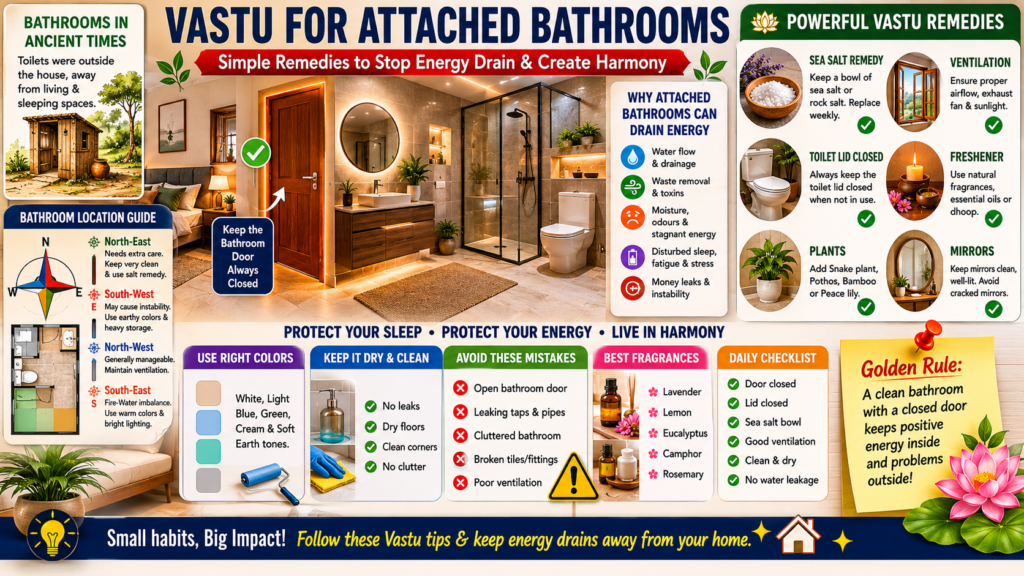
North-East Bathroom
The North-East is associated with:
- spirituality,
- clarity,
- peace,
- intuition.
This is traditionally considered the most sensitive location for a bathroom.
Remedies
- keep extremely clean,
- maximize natural light,
- use light colors,
- place sea salt bowls.
South-West Bathroom
The South-West represents:
- stability,
- grounding,
- security.
Bathrooms here are often associated with:
- instability,
- uncertainty,
- emotional imbalance.
Remedies
- use earth-tone colors,
- keep heavy storage organized,
- ensure excellent maintenance.
North-West Bathroom
This direction relates to:
- movement,
- communication,
- relationships.
Bathrooms here are generally considered more manageable.
Remedies
- maintain airflow,
- avoid clutter,
- use neutral colors.
South-East Bathroom
The South-East represents:
The Fire Element
Since bathrooms are dominated by Water energy, this creates a Fire-Water imbalance.
Remedies
- use warm accent colors,
- improve lighting,
- maintain cleanliness.
The Golden Rule: Keep the Bathroom Door Closed
One of the simplest and most recommended Vastu remedies is:
Keep the bathroom door closed when not in use.
Why?
Symbolically, this helps contain:
- draining energy,
- odors,
- humidity,
- visual clutter.
Practically, it also:
- improves hygiene,
- protects bedroom comfort,
- reduces moisture spread.
Sea Salt Remedies for Bathroom Energy
Sea salt is one of the most popular Vastu remedies.
How to Use It
Place a small bowl of:
- sea salt,
- rock salt,
- Himalayan salt
inside the bathroom.
Many Vastu practitioners believe salt helps:
- absorb stagnant energy,
- neutralize negativity,
- refresh the atmosphere.
Replace the salt regularly.
Ventilation and Air Circulation
Poor ventilation is one of the biggest bathroom problems.
Improve Airflow Through:
- exhaust fans,
- open windows,
- dehumidifiers,
- natural ventilation.
Good airflow prevents:
- dampness,
- odors,
- mold,
- and stagnant energy.
Mirrors and Bathroom Energy
Mirrors are often discussed in Vastu.
General recommendations include:
Do
- keep mirrors clean,
- ensure they are well-lit,
- maintain good condition.
Avoid
- cracked mirrors,
- dirty mirrors,
- distorted reflections.
Clean reflective surfaces improve the feeling of openness and cleanliness.
Toilet Seat Position and Lid Rules
One simple modern Vastu recommendation:
Keep the toilet lid closed when not in use.
Benefits include:
- improved hygiene,
- reduced visual clutter,
- symbolic containment of draining energy.
This is also recommended by many hygiene experts.
Colors That Balance Bathroom Energy
Color influences how a space feels emotionally.
Recommended Bathroom Colors
- white,
- cream,
- light blue,
- soft gray,
- pale green.
These colors promote:
- cleanliness,
- calmness,
- freshness.
Avoid overly dark colors in small bathrooms.
Plants That Help Neutralize Bathroom Energy
Certain plants thrive in humid conditions.
Popular choices include:
Bathroom-Friendly Plants
- snake plant,
- pothos (money plant),
- peace lily,
- bamboo.
Benefits:
- improved aesthetics,
- fresher atmosphere,
- natural greenery.
Vastu Tips for Attached Bathrooms in Bedrooms
When the bathroom connects directly to the bedroom:
Helpful Remedies
✔ Keep the door closed
✔ Keep the bathroom dry
✔ Use good ventilation
✔ Remove unnecessary clutter
✔ Use pleasant fragrances
✔ Keep drains functioning properly
✔ Maintain bright lighting
These steps help create clearer separation between:
- sleep energy,
- and bathroom energy.
Common Bathroom Vastu Mistakes
1. Water Leaks
Leaks symbolize ongoing energy and resource loss.
2. Damp Corners
Create heaviness and discomfort.
3. Cluttered Countertops
Reduce visual calmness.
4. Broken Fixtures
Represent neglected maintenance.
5. Poor Ventilation
Creates stagnant conditions.
Daily Bathroom Energy Checklist
Before ending your day:
✅ Toilet lid closed
✅ Bathroom door closed
✅ No standing water
✅ Good ventilation
✅ No clutter
✅ Dry surfaces
✅ Fresh fragrance
✅ Clean mirrors
These small habits create a more balanced environment.
FAQs About Bathroom Vastu
1. Are attached bathrooms bad Vastu?
Not necessarily. Proper maintenance and remedies can significantly improve bathroom energy.
2. Why is sea salt used in Vastu?
Many practitioners believe it helps absorb stagnant or negative energy.
3. Should the bathroom door stay closed?
Yes. This is one of the most commonly recommended remedies.
4. Is a North-East bathroom always harmful?
Not always, but it often requires additional attention and maintenance.
5. What plants are good for bathrooms?
Snake plants, pothos, peace lilies, and bamboo are popular choices.
6. Does Vastu recommend keeping the toilet lid closed?
Yes, both for symbolic and practical reasons.
Conclusion
Attached bathrooms are a reality of modern living.
Fortunately, Vastu does not demand major renovations for every bathroom concern.
Instead, it emphasizes:
- cleanliness,
- airflow,
- maintenance,
- organization,
- and simple remedies.
By following easy practices such as:
- keeping the door closed,
- using sea salt,
- improving ventilation,
- maintaining cleanliness,
- and fixing leaks promptly,
you can create a bathroom that supports both practical comfort and energetic balance.
The goal of Vastu is not perfection.
The goal is creating a home that feels:
- healthy,
- peaceful,
- organized,
- and supportive of your daily life.