The Vastu Purusha Mandala Demystified
One of the most fascinating concepts in Vastu Shastra is the mysterious figure known as the Vastu Purusha — a cosmic being believed to lie beneath every structure on Earth.
According to ancient Indian tradition, every home, temple, building, and city is built upon the body of this celestial being. The way a structure aligns with his body determines how energy flows within the space.
This ancient idea forms the foundation of the Vastu Purusha Mandala, the sacred energy map used in Vastu design.
But who exactly is the Vastu Purusha?
And why is he lying face down beneath your home?
Let’s explore the fascinating mythology and symbolism behind this ancient cosmic story.
What Is the Vastu Purusha Mandala?
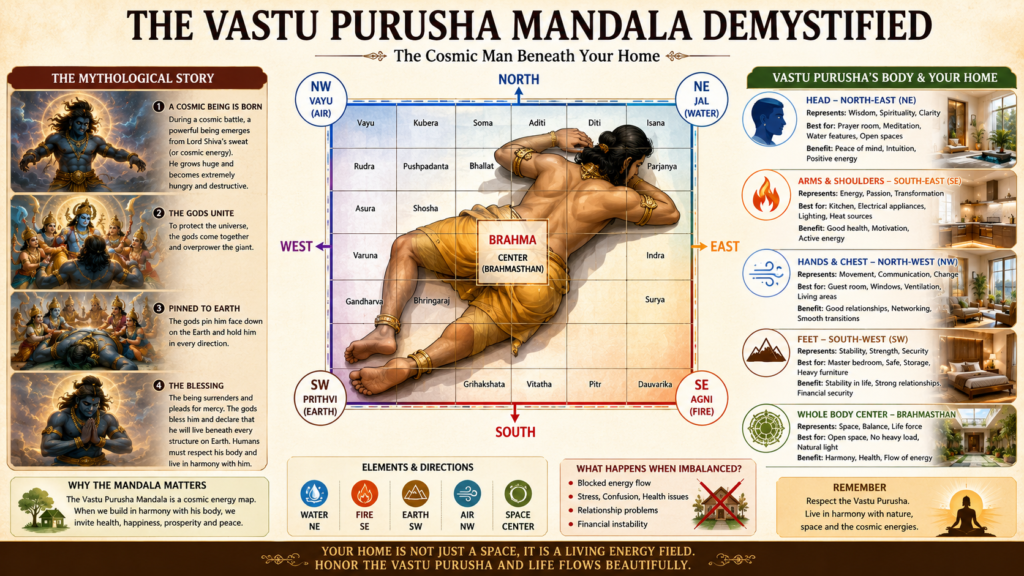
The Vastu Purusha Mandala is a sacred geometric diagram used in Vastu Shastra.
It is:
- an energy grid,
- a directional map,
- and a symbolic representation of cosmic balance.
The Mandala divides a space into sections connected to:
- directions,
- planetary energies,
- natural elements,
- and divine forces.
At the center of this Mandala lies the Vastu Purusha, the cosmic being whose body represents the energetic structure of a building.
The Mythological Story of the Vastu Purusha
How the Cosmic Being Was Created
According to Hindu mythology, a powerful being suddenly emerged during a cosmic battle between Lord Shiva and a fierce demon.
Some legends say:
- the being was created from Shiva’s sweat,
- while others describe him as a manifestation of chaotic cosmic energy.
This giant being became extremely hungry and powerful. He began consuming everything around him and threatened the balance of the universe.
The gods feared his uncontrollable energy.
Why the Gods Pinned Him Down
To stop the chaos, the gods joined forces and pinned the giant being face down against the Earth.
Different gods held different parts of his body:
- Brahma controlled the center,
- other deities guarded the directions,
- and the cosmic being became trapped beneath the land.
The being pleaded for mercy.
The gods then blessed him and declared:
“You will live beneath every structure built on Earth. Humans must respect your body and align their homes with cosmic harmony.”
That cosmic being became known as:
Vastu Purusha
And his body became the foundation of Vastu architecture.
Understanding the Vastu Purusha Mandala Grid
The Vastu Purusha Mandala is usually shown as:
- a square grid,
- divided into smaller sections,
- with the Vastu Purusha lying diagonally face down.
Each section represents:
- specific energies,
- directions,
- natural elements,
- and areas of life.
The Mandala acts like an energetic blueprint for designing homes and temples.
How the Body of Vastu Purusha Maps a Home
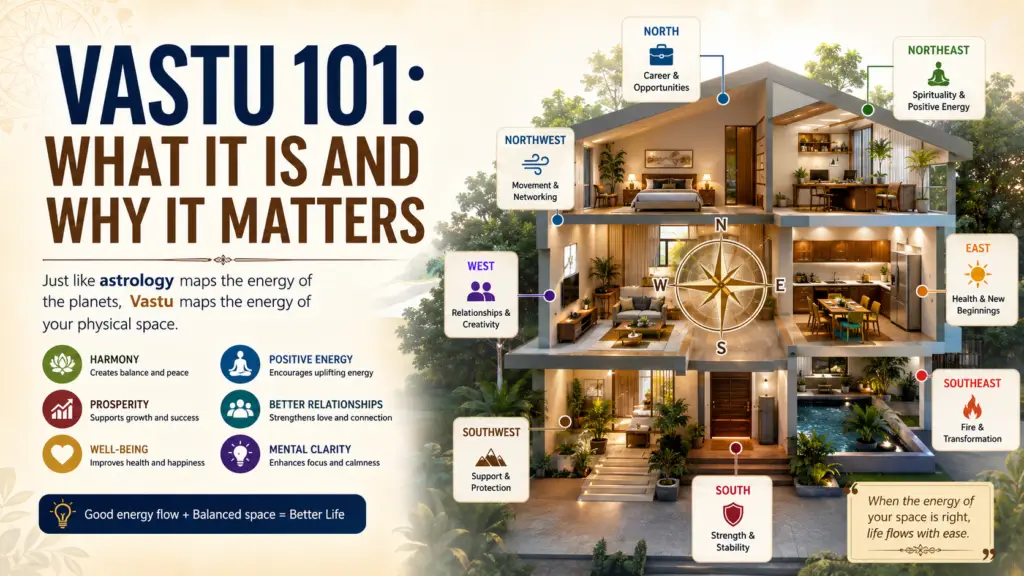
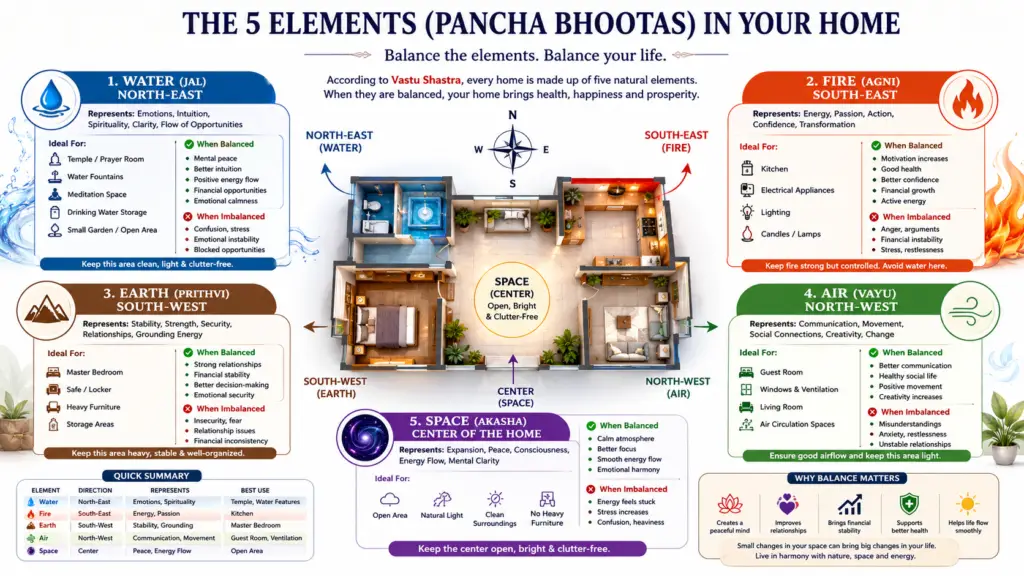
Every part of the Vastu Purusha’s body corresponds to a direction and type of energy.
This is why room placement matters in Vastu.
Head in the North-East
The head of the Vastu Purusha lies in the:
North-East direction
This area represents:
- wisdom,
- spirituality,
- intuition,
- clarity,
- and divine energy.
Best Uses
- Prayer room
- Meditation area
- Water elements
- Open spaces
Why It Matters
Blocking or cluttering this area is believed to disturb mental peace and spiritual harmony.
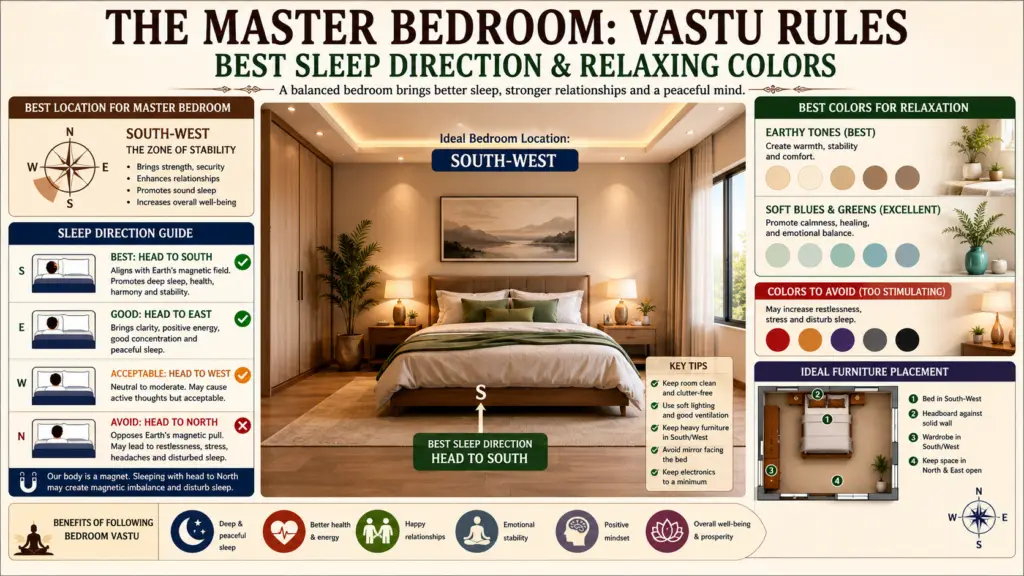
Feet in the South-West
The feet of the Vastu Purusha rest in the:
South-West direction
This zone represents:
- stability,
- grounding,
- security,
- and strength.
Best Uses
- Master bedroom
- Heavy furniture
- Safe or storage
Why It Matters
A weak South-West may create instability in relationships and finances.
Fire in the South-East
The South-East is associated with:
Agni (Fire Energy)
This direction governs:
- passion,
- energy,
- transformation,
- and action.
Best Uses
- Kitchen
- Electrical appliances
- Cooking area
Why It Matters
Placing water elements here may symbolically weaken fire energy and create imbalance.
Air in the North-West
The North-West represents:
Vayu (Air Energy)
This area influences:
- movement,
- communication,
- networking,
- and social interactions.
Best Uses
- Guest room
- Windows
- Ventilation spaces
Why It Matters
Poor airflow here may increase restlessness and misunderstandings.
Why Directions Matter in Vastu
In Vastu, directions are not random.
Each direction carries a unique energetic frequency connected to:
- sunlight,
- magnetic fields,
- natural elements,
- and cosmic symbolism.
The Vastu Purusha Mandala helps organize these energies harmoniously.
That’s why Vastu focuses heavily on:
- room placement,
- entrances,
- sleeping directions,
- and spatial balance.
Symbolism of the Cosmic Man
The Vastu Purusha is more than mythology.
He symbolizes:
- the connection between humans and nature,
- cosmic balance,
- and the idea that every space is alive with energy.
His body reminds us that:
A home is not just a structure — it is an energetic environment.
What Happens When Energy Is Disturbed?
According to Vastu philosophy, imbalance may occur when:
- clutter blocks energy,
- elements are misplaced,
- directions are ignored,
- or the home feels heavy and chaotic.
This may lead to:
- stress,
- emotional tension,
- lack of focus,
- relationship conflicts,
- or financial instability.
Whether viewed spiritually or psychologically, environment strongly influences emotions and behavior.
Modern Relevance of the Vastu Purusha Mandala
Even today, many architects and homeowners use Vastu principles to create spaces that feel:
- calm,
- balanced,
- productive,
- and emotionally supportive.
Interestingly, many Vastu ideas align with modern design principles:
- natural light improves mood,
- open spaces reduce stress,
- airflow increases comfort,
- and organized homes improve mental clarity.
Beginner-Friendly Vastu Tips
You don’t need to rebuild your house to apply Vastu principles.
Simple Ways to Start
- Keep the North-East clean and open
- Avoid clutter in the center of the home
- Improve natural light and airflow
- Place heavy furniture in the South-West
- Keep entrances bright and welcoming
Small changes can create noticeable shifts in how a space feels.
Common Myths About Vastu
Myth 1: Vastu Is About Fear
Reality:
Vastu is about balance and harmony, not punishment.
Myth 2: Small Mistakes Ruin Everything
Reality:
Minor imbalances do not destroy your life.
Myth 3: Vastu Is Only Religious
Reality:
Many Vastu ideas are practical and connected to environmental psychology.
FAQs About Vastu Purusha Mandala
1. Who is the Vastu Purusha?
The Vastu Purusha is the cosmic being believed to lie beneath every structure according to Vastu mythology.
2. What is the Vastu Purusha Mandala?
It is a sacred grid representing the energetic blueprint of a space.
3. Why is the North-East important in Vastu?
The North-East is associated with spirituality, clarity, and positive energy.
4. Is Vastu scientifically proven?
Some principles align with practical design concepts like light, airflow, and organization.
5. Do I need to rebuild my house for Vastu?
No. Small adjustments can help improve energy flow.
6. Is Vastu connected to astrology?
Yes. Both systems study energy — astrology focuses on cosmic energy, while Vastu focuses on spatial energy.
Conclusion
The story of the Vastu Purusha is one of the most symbolic and fascinating ideas in ancient Indian wisdom.
It teaches us that:
- homes are living energy systems,
- directions carry meaning,
- and balanced spaces support balanced lives.
The Vastu Purusha Mandala is not just mythology — it is a reminder that our surroundings influence our emotions, thoughts, and daily experiences.
By understanding the cosmic map beneath a home, we begin to see space not just as architecture, but as energy in motion.